
Construction Technology · Contech
Durability is a carbon strategy
Lowering the carbon in a cubic metre of concrete is worth doing. Making the structure last twice as long is often worth more, and gets discussed far less.
Most conversations about concrete and carbon are about the mix: less clinker, supplementary cementitious materials, alternative binders. That work matters, and the industry has made real progress on it.
But it addresses only one term in the equation. A structure’s carbon is the carbon in its materials divided across the years it serves. Halve the embodied carbon and you improve that figure by half. Double the service life and you improve it by half as well — and the second route is frequently cheaper, less novel, and easier to specify.
The two aren’t alternatives. The point is that only one of them is usually on the agenda.
Why replacement is the expensive failure
When a structure is replaced early, you pay the carbon twice and then some: demolition, disposal, new materials, new construction, and the disruption around it. A bridge deck designed for sixty years and replaced at thirty-five hasn’t just underperformed — it has roughly doubled its lifetime carbon intensity, whatever the mix design said on day one.
This is why durability belongs in the carbon conversation rather than in a separate discussion about maintenance budgets. Early replacement is the single largest avoidable emission in most infrastructure portfolios.
What actually ends a concrete structure’s life
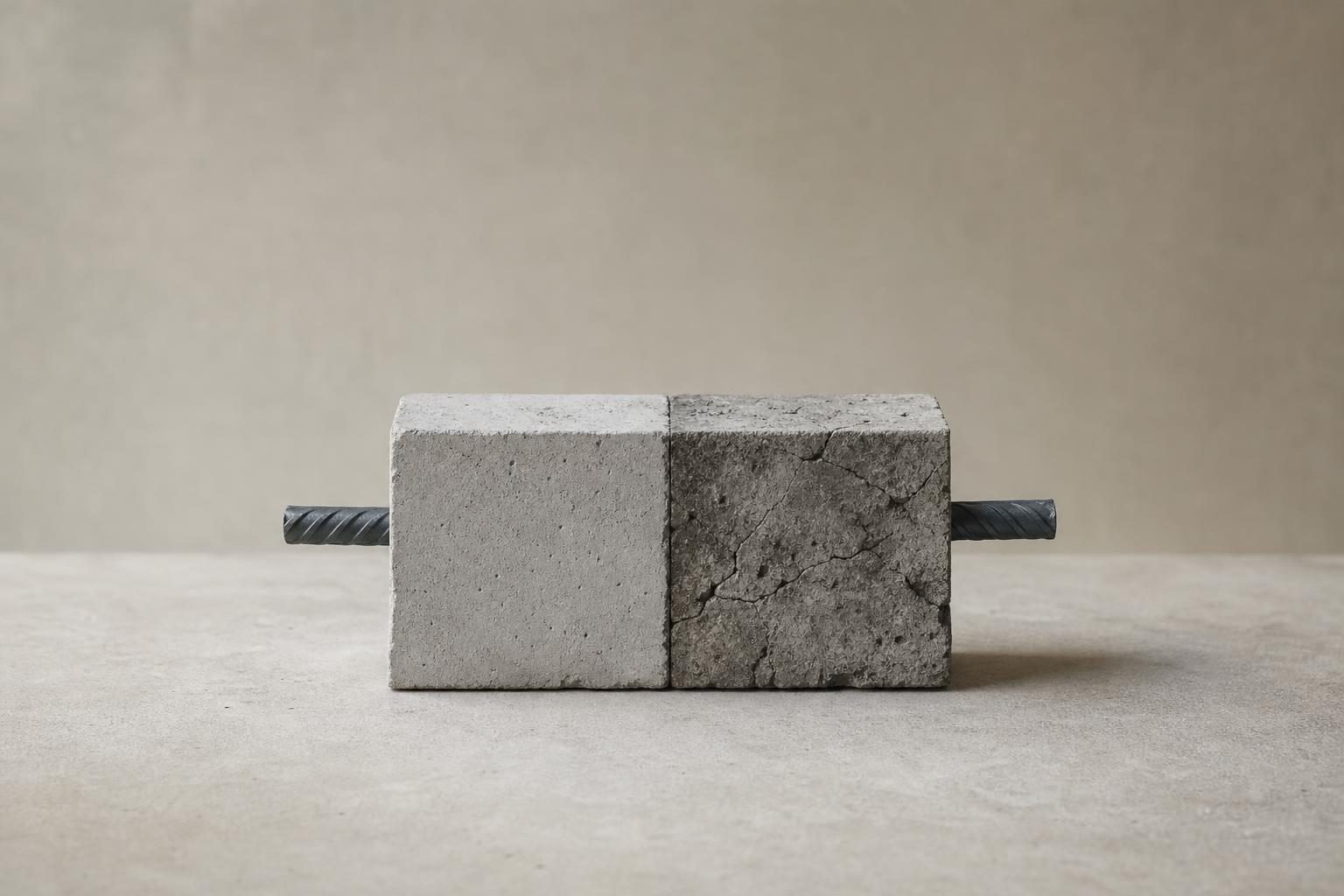
Rarely the concrete running out of strength. Almost always something getting to the reinforcement:
Chloride ingress. De-icing salt and marine exposure. Chlorides migrate through the cover, depassivate the steel, and corrosion begins. The expanding corrosion product cracks the cover, which admits more chloride. It accelerates.
Carbonation. Atmospheric CO₂ reacts with the pore solution and lowers its alkalinity until the steel’s passive layer no longer holds. Slower, and more relevant in sheltered urban exposure.
Freeze–thaw. Water in the pore structure expands on freezing. Without adequate entrained air, repeated cycles do cumulative damage.
Restraint cracking. Early-age thermal and shrinkage movement that the structure isn’t free to accommodate. Cracks formed in week one become the transport paths for everything above.
Three of those four are transport problems: how easily aggressive agents move through the cover. Which means durability is mostly decided by permeability and cover depth — and both are determined on site, not in the specification.
The gap between specified and delivered
A durability specification describes the concrete that was intended. The structure gets the concrete that was placed, compacted and cured.
The common losses:
- Cover. Specified cover is a minimum. Spacers move, reinforcement is walked on, and the delivered cover is frequently less than drawn. A few millimetres short can cost years.
- Curing. The most under-resourced step on most sites. Inadequate early curing leaves a more permeable surface zone — exactly the layer that has to resist ingress.
- Compaction. Voids are direct routes inward.
- Added water. Water added for workability raises the water–binder ratio and the permeability with it.
None of these appear in a compressive strength test. A cube can pass comfortably while the cover zone that determines service life is substantially worse than specified.
Measure what you care about
If durability is the goal, test for transport properties rather than inferring them from strength. Measures of permeability, water absorption or chloride migration speak directly to the mechanisms that end a structure’s life. They can be specified, and they can be checked on delivered work rather than on a laboratory cube.
The same logic applies to monitoring. Instrumenting a structure to detect the onset of corrosion — rather than waiting for spalling to make it visible — turns a replacement into a repair. That is a large carbon saving that never appears in anyone’s materials calculation.
How to put it in a specification
Three changes do most of the work:
- Specify a service life, not just a strength class. It forces exposure conditions and transport properties into the conversation.
- Verify cover on the delivered structure. Survey it; don’t assume it.
- Treat curing as a controlled activity with a method and a check, not as something that happens if the weather allows.
None of this is exotic. It’s the unglamorous half of low-carbon construction — and in most projects it’s where the larger number is sitting.
Braincrete develops smart, sustainable concrete technology for durable, low-carbon infrastructure. More at braincrete.com.