
Construction Technology · Contech
When Concrete Cracks: Designing for Repair, Not Failure
In civil engineering, a crack is often treated as a warning sign. But in self-healing concrete systems, a crack does not always mark the start of failure. In the right conditions, it can become...
In civil engineering, a crack is often treated as a warning sign. But in self-healing concrete systems, a crack does not always mark the start of failure. In the right conditions, it can become the point where repair begins.
That shift matters for how we specify, detail, and maintain infrastructure. The practical question is not whether concrete can heal every defect. It is which cracks are worth designing for. For Braincrete, the answer begins with understanding the crack type, the exposure condition, and the maintenance strategy that will support the material system over time.
Not Every Crack Belongs to a Self-Healing Strategy
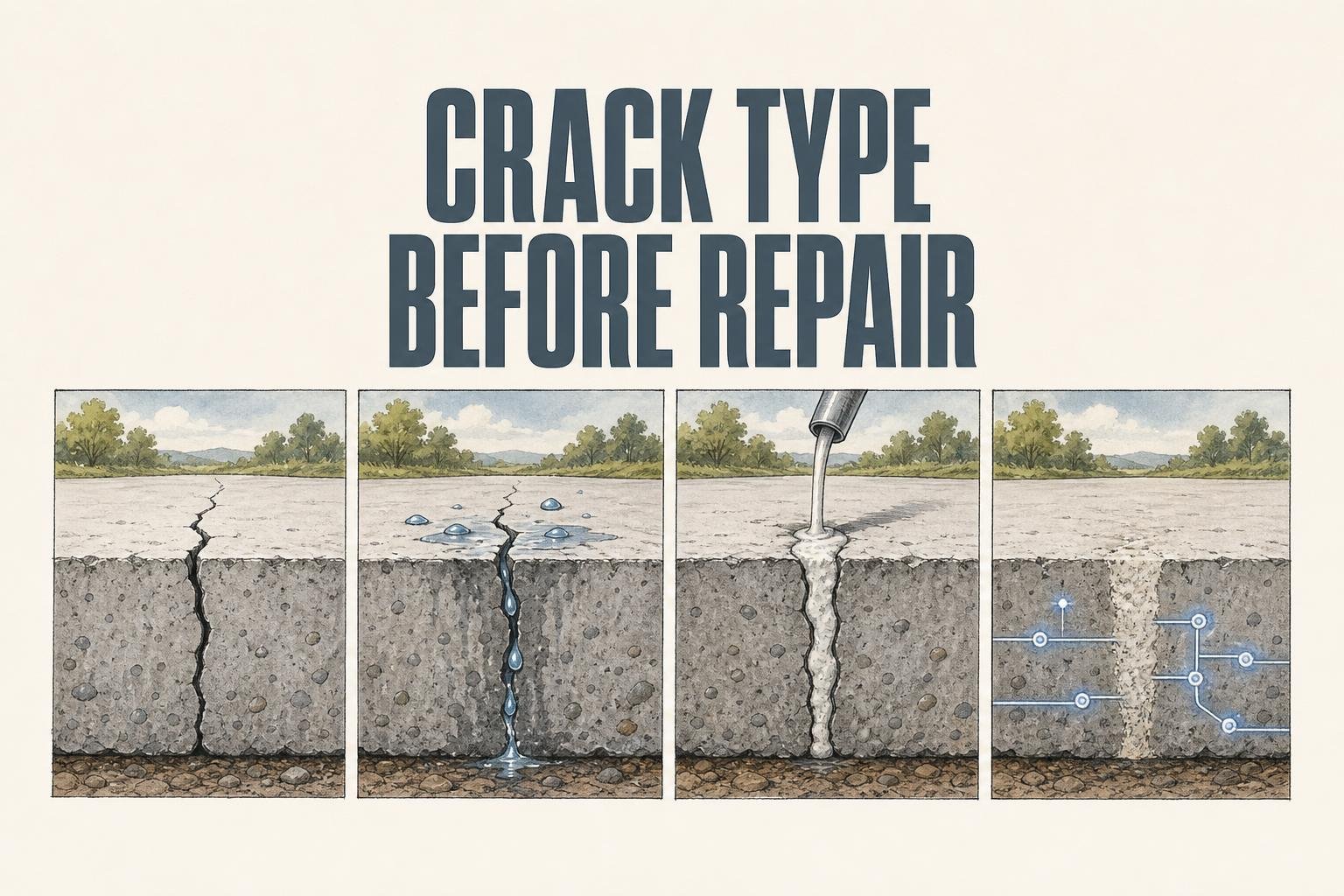
Self-healing concrete is not a universal replacement for conventional engineering. Narrow cracks in damp, low-access areas are the best fit for healing mechanisms that react with water, air, or embedded bacteria and form new material inside the gap. In those conditions, the material logic aligns with the problem we are trying to solve.
But active movement joints, wide cracks, and poor detailing still require standard engineering responses. Self-healing does not remove the need for proper structural design. It only adds value when the crack pattern and exposure match the behavior of the healing mechanism.
That is why the specification process must be deliberate. A healing system should be selected because it fits the crack environment, not because it sounds advanced. In infrastructure delivery, precision matters more than novelty.
Why Exposure and Access Shape the Outcome
Concrete does not crack in isolation. The surrounding environment influences whether a crack can remain stable, whether moisture can support the healing reaction, and whether maintenance crews can inspect the area easily. Low-access zones are especially relevant because they are harder to monitor and repair using conventional methods.
When the exposure is suitable, self-healing mechanisms can help reduce the need for intervention in those difficult locations. When the exposure is unsuitable, the system may not deliver the intended benefit. That is why the engineering decision must account for site conditions, not just material properties.
This is also where project teams can avoid overpromising performance. Self-healing concrete is most useful when it is matched to a specific crack behavior and a realistic maintenance plan. It is a structural tool, not a blanket solution.
Smart Concrete Adds Visibility to the System
Self-healing is one layer of control. Smart concrete adds another. Sensors or conductive elements can track strain, moisture, temperature, or crack activity so the team can see where change is happening before it becomes a larger repair.
For civil teams, that visibility changes the maintenance conversation. Instead of waiting for a defect to become obvious, project teams can use data to understand how the structure is behaving. That makes the system more responsive and more aligned with long-term asset management.
In practice, the value is not only in detecting movement. It is in connecting material behavior with decision-making. If the crack is active, if the exposure is changing, or if moisture conditions are shifting, the data can inform how and when maintenance should happen.
How Project Teams Should Evaluate Self-Healing Concrete
The useful test is straightforward: define the crack type, match the healing mechanism to the exposure, and decide how the data will guide maintenance. That sequence keeps the system grounded in engineering logic.
For Braincrete, this is where innovation becomes practical. Self-healing systems and smart concrete are most effective when they are treated as part of a broader structural strategy. They support durability, but only when the design intent is clear and the detailing is sound.
For teams working on infrastructure, the goal is not to heal everything. The goal is to design concrete systems that know where repair can begin, where conventional methods are still required, and how performance will be monitored over time. Braincrete explores that intersection between material behavior and structural delivery.
When the crack pattern, exposure, and maintenance plan align, concrete can do more than resist damage. It can become part of its own repair strategy. Learn more about Braincrete and how self-healing and smart concrete concepts support the future of infrastructure.